Japan Design Workshop (JDW) centers on the inquiry of Continuity and Transformation in Japanese architecture, regionalism, and community form. A large topic, often culturally-based, yet a phenomena that is increasingly global and universal, affecting the quality of life and the quality of the environment all around us. Within this complexity, our studies will take a slice of particularity in architectural form-giving in actual context. We are interested in the physical form and spatial quality which respond to and sustain the continuity of a people's connection to their natural surrounding, climate, traditions and long-established place-making.
Colophon
-
Workshop led by
Shun Kanda -
Producer
Brian Orser -
Producer
Nima Zamanpour -
Website Development by
Mianwei Wang -
Contributing Editor
Ami Kurosaki -
Contributing Archivist
Laura Zawarski
Reflections
Toponyms often entice one's curiosity to know more. Salzburg, Salinas, Droitwich, Salt Lake City - all to do originally with salt production. In my native Japan there's Oshio ⼤塩 - "big salt".
MIT Japan Design Workshops (JDW 1990~2016) have taken place with fascinating geographical names such as Kawanami 河並 - riverside, Ikeoku 池奥 - "beyond the pond", Toukaichi ⼗⽇市 -"tenth day market", Oginoshima 荻ノ島 - "silvergrass island" , Omotesando 表参道 - "frontal shrine approach". What stories lurk within these place names?
The town of Oshio had long been settled as a productive salt-field since the 8th century during Japan's Nara period. Today, this gentle crescent-shaped coastland facing the Inland Sea lies vacant, devoid of activity and people. What happened? The town elders informed us over numerous meetings.
Everyone in Tokyo is familiar with Omotesando, the zelkova-lined boulevard known for the high-end most popular shopping steet in this bustling world city. As well, the avenue is an open-air museum of modern architectural eye candy showcasing internationally famous brand name boutiques. Omote-sando "frontal approach" to Meiji Shrine was originally created to honor the deified spirits of Emperor Meiji (1912-1926) - the largest Shinto shrine hidden in the heart of the city. JDW interceded with a street performance asking passers-by on how relevant is this cognizance today?
From its inception, it was my intention that JDW relied on a basic concept and methodology - that the workshop required specific in situ engagements. The project contexts were selected for their characteristic genius loci and assured exchanges with the resident population. Most importantly, an inquiry had to be formulated of benefit to our academic objectives and hopefully to contribute responsibly to the real-time issues faced by each of the community we visited.
Thus was spawned the title of our Japan Design Workshop -
Contunuity / Transformation in Architecture and Community Form.
Shun Kanda, Founding Director JDW
MIT School of Architecture & Planning
JDW spent a week in Kawanami, a small town lined with roadside waterways. While being invited to the Tonomura home, we noticed a pond in their traditionally landscaped garden. The family explained that the naturally-fed water level had dropped by a meter, about the same drop as that of Japan's largest Lake Biwa 20km away. No more koi fish to enjoy.
"Lorem ipsum dolor sit amet, consectetur adipiscing elit. Sed elementum condimentum orci, ac porta dui porttitor feugiat."
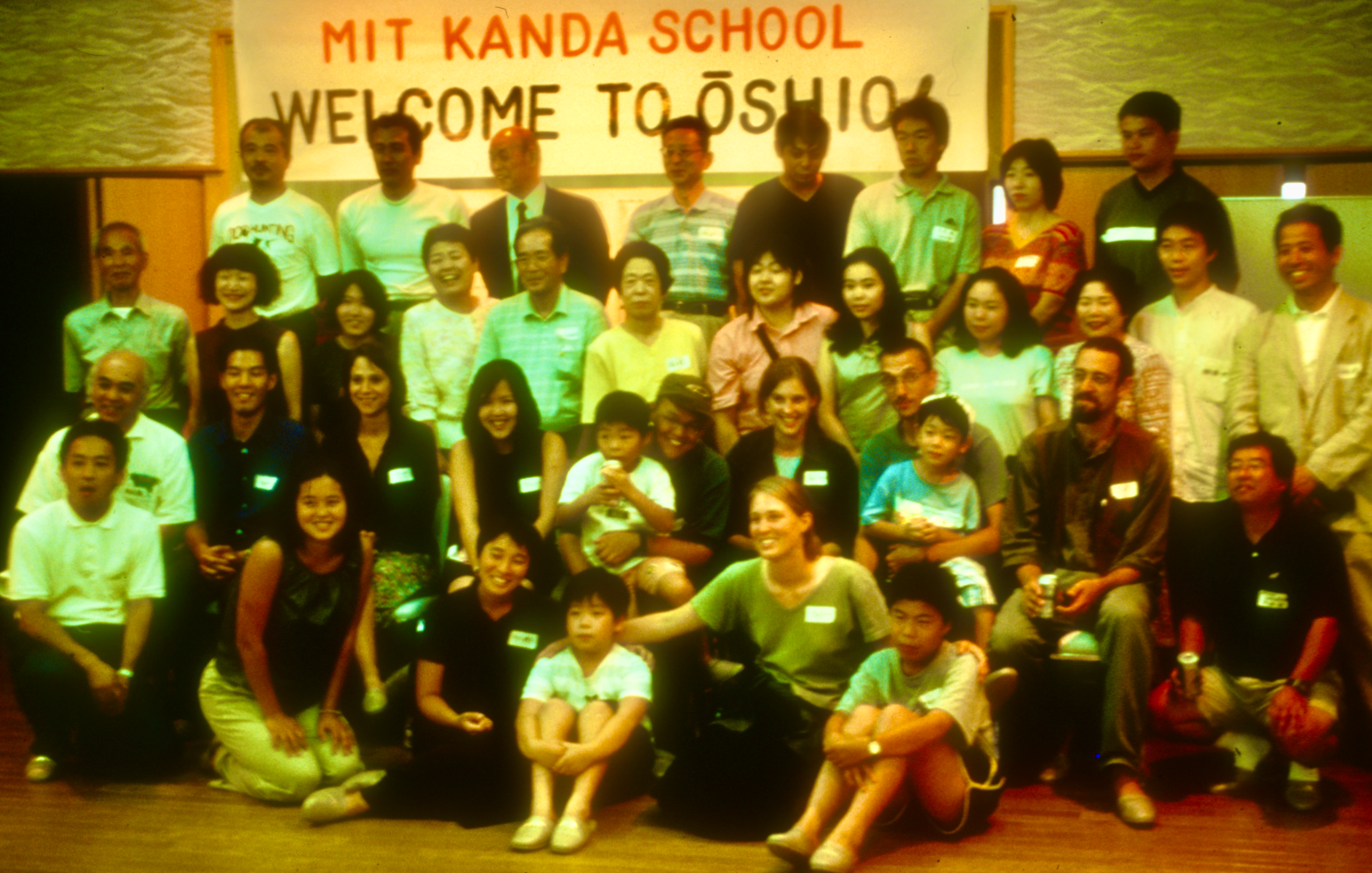
From our time in Oshio....